


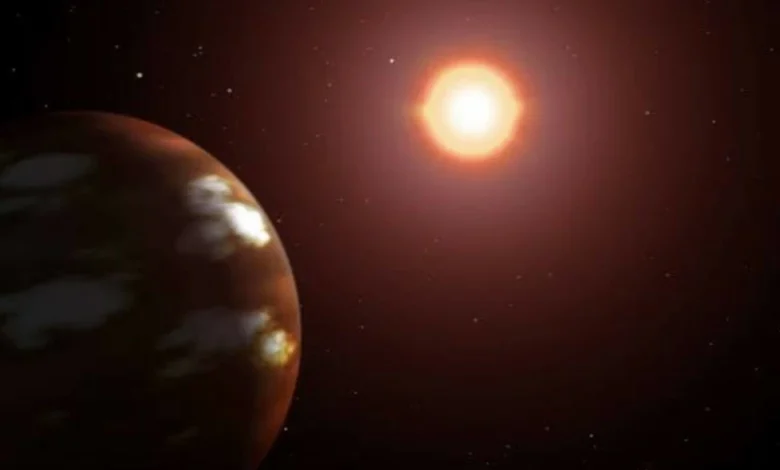
أعلنت وكالة الفضاء الأمريكية «ناسا» عن اكتشاف كوكبين عملاقين جديدين يُصنفان ضمن أكثر الكواكب انخفاضاً في الكثافة حتى الآن.
وأوضحت «ناسا» أن الكوكبين، اللذين يحملان اسمي «TOI-791 b» و«TOI-791 c»، يدوران حول نجم شبيه بالشمس يعرف باسم «TOI-791» ويقع على بعد نحو 1113 سنة ضوئية من الأرض. تم رصدهما من خلال مراقبة الانخفاضات المتكررة في سطوع النجم أثناء مرورهما أمامه.
وأظهرت البيانات أن الكوكب «TOI-791 b» يقارب كوكب المشتري حجماً، لكنه لا يمتلك سوى 3٪ من كتلته، فيما يتجاوز «TOI-791 c» المشتري حجماً مع امتلاكه 5.9٪ فقط من كتلته، ما يجعلهما ضمن فئة نادرة من الكواكب العملاقة منخفضة الكثافة.
تمكن القمر الصناعي «TESS» في هذه المهمة من جمع بيانات عن هذا النظام الكوكبي على مدى 1122 يوماً خلال سبع سنوات، ما أتاح للعلماء دراسة دقيقة لحركة الكوكبين وخصائصهما الفيزيائية.
كما تشير التحليلات إلى أن الكوكبين يرتبطان بتأثيرات جاذبية متبادلة تؤثر في توقيت عبورهما أمام النجم المضيف، وهو ما استخدمه العلماء لحساب كتلتيهما بدقة وتأكيد انخفاض كثافتهما بصورة استثنائية.
ويرى العلماء أن دراسة هذين الكوكبين قد تسهم في تحسين فهم آليات تشكل الكواكب العملاقة وتطور الأنظمة الكوكبية، إضافة إلى توفير معلومات جديدة حول تركيب الأغلفة الجوية للكواكب منخفضة الكثافة وكيفية تطورها عبر الزمن.
The American space agency “NASA” has announced the discovery of two new giant planets classified as some of the lowest density planets found to date.
NASA explained that the two planets, named “TOI-791 b” and “TOI-791 c,” orbit a sun-like star known as “TOI-791,” located about 1,113 light-years from Earth. They were observed through monitoring the repeated dips in the star’s brightness as they passed in front of it.
The data showed that the planet “TOI-791 b” is roughly the size of Jupiter, but has only 3% of its mass, while “TOI-791 c” exceeds Jupiter in size with only 5.9% of its mass, placing them in a rare category of low-density giant planets.
The “TESS” satellite was able to collect data on this planetary system over 1,122 days during seven years, allowing scientists to conduct a precise study of the planets’ movements and their physical characteristics.
Analyses also indicate that the two planets are linked by mutual gravitational effects that influence the timing of their transits in front of the host star, which scientists used to accurately calculate their masses and confirm their exceptionally low densities.
Scientists believe that studying these two planets could contribute to a better understanding of the mechanisms behind the formation of giant planets and the evolution of planetary systems, as well as provide new information about the composition of the atmospheres of low-density planets and how they evolve over time.
